
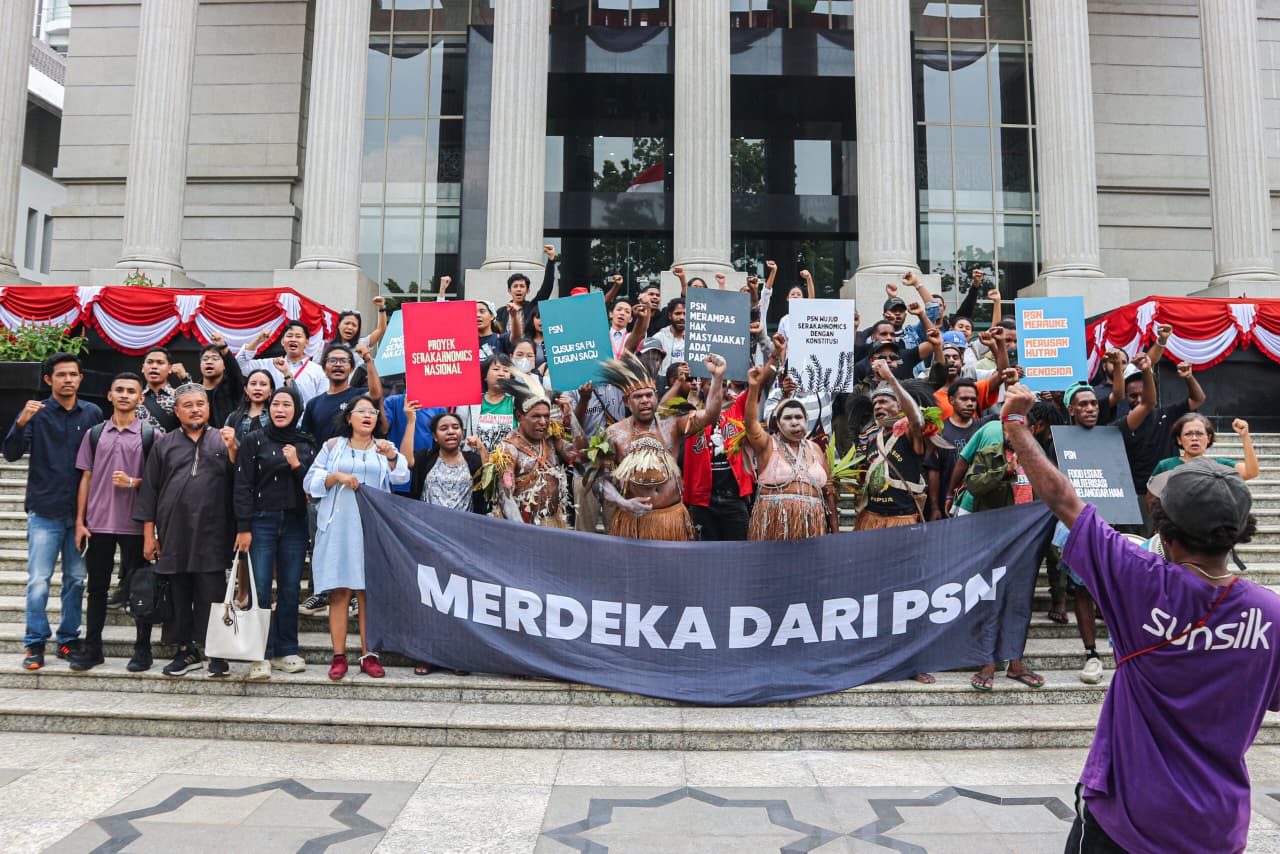
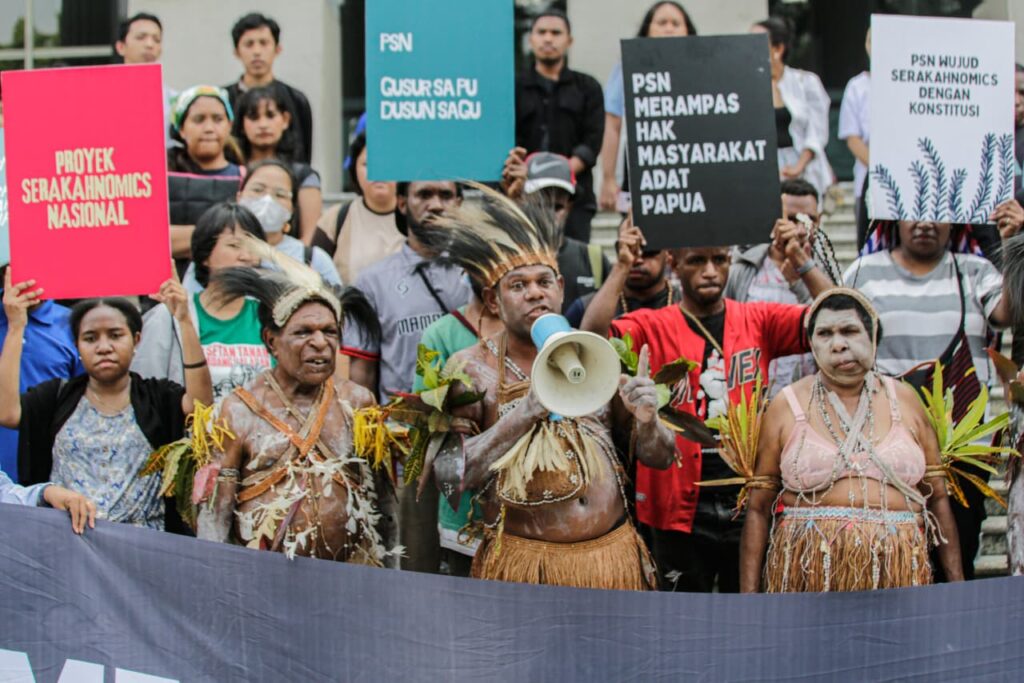
Images Source: https://pusaka.or.id/galleries/perlawanan-lintas-generasi/
Author: Intan Nurawalia – 242122111053
Development in Papua: Driven by Invesment Interest Rather than the Welfare of Papuan People
Introduction
What do you think would happen if a place were blessed with abundant natural resources, including gold, copper, oil, gas, timber, and tropical forests? it would be very rich and prosperous, wouldn’t it? in reality, the province of Papua in Indonesia which possesses all these resources is actually the poorest and most underdeveloped in the country in terms of education, health, and infrastructure (Fahmi & Siddiq Armia, 2022; Wangge & Lawson, 2023).
Large-scale investment in food security and economic growth has become a global trend, particularly in developing countries with vast land areas, such as Indonesia (Maris Phoek et al., 2025). Papua is one of the regions in Indonesia with exceptionally high biodiversity, with forests, rivers and seas that support the livelihoods and economy of Papuan people (Ungirwalu et al., 2021; Saefullah et al., 2024; Gaveau et al., 2021). Papua is often referred to as one of the ‘lungs of the world’, as well as a source of timber, oil palm plantations, also food and energy crops for commodities such as oil palm, timber and minerals, which drive corporate expansion (Jasmine et al., 2025; Pattiselanno & Krockenberger, 2021; Saunders et al., 2024).
Unsurprisingly, this wealth of natural resources makes Papua a goldmine for investment and large-scale economic development, with Papua’s economy underpinned by abundant gas reserves and metal mines, including the Grasberg Mine and PT Freeport, which is one of the largest gold and copper mines in the world (Saunders et al., 2024; Munawaroh & Haryanto, 2021). Despite all its natural resources, Papua has in fact remained the poorest province in Indonesia from 2011 to 2024 (Rabbani et al., 2025; Said et al., 2025; Indrasari & Yulianto, 2025).
Research by Susanto and Wulandari (2021) as well as Saifullah and Yawan (2022) converge on the finding that poverty stems from a lack of access to clean water, sanitation, nutritious food, and healthcare services, which ultimately affects the level of education and the long-term well-being of the Papuan people. These findings are supported by the results of an analysis covering the period 2021–2023, which reveal that the average level of education among the Papuan population is only up to junior high school or the start of senior high school (Indrasari & Yulianto, 2025).
However, the suffering of the Papuan people does not end there, as human rights analyses highlight acts of violence against the Papuan people committed by state officials and armed military groups in order to exploit natural resources and fuel ecological conflicts, which have given rise to long-term structural violations against indigenous Papuan communities (Fahmi & Siddiq Armia, 2022; Muslimin Muslimin, 2025). The structural and long-standing violations against communities and the exploitation of natural resources in Papua did not happen by chance; as demonstrated by research conducted by Sukandar and Nurcahyani (2021), which revealed that historically, the Freeport licence covering a major gold mine in Papua was granted by President Suharto in 1967, even before the Papuan people had decided whether they wished to join Indonesia or become independent. Tellingly, this historical event, which took place without the participation or say of the Papuan people, has fostered the view that, on the ground, Indonesia and the foreign-controlled Freeport are the new colonisers of the Papuan people (Hidayatulloh et al., 2022).
Based on the background, research, and historical facts outlined above, development in Papua is structurally tailored to the needs of investors and political elites, sidelining the views and welfare rights of the indigenous Papuan communities. This position is substantiated by three interconnected patterns: land clearing and the extraction of natural resources being prioritised for investors over Papuan people’s rights, administrative restructuring driven by the interests of the elite and economic-political, and the benefits of development and infrastructure failing to be distributed equitably amongst the Papuan people.
I. Reasons that Support the Thesis Statement
A. Land clearing and the extraction of natural resources are prioritised for investors over local Papuan people’s rights
An analysis of the political dynamics surrounding the development of oil palm plantations shows that a number of high-ranking officials and companies derive income from the sale of permits and timber harvested from land clearing, whilst indigenous Papuan communities lose their land and rights because they are often in a position of ‘legal limbo’ due to their lack of legal standing (Berenschot & Dhiaulhaq, 2025). A case in point is the research by Padang et al. (2025), which uncovered a case in the Kebar Valley, West Papua, where Papuan people faced intimidation due to the expansion of oil palm plantations, which subsequently triggered land conflicts, violence, and ecological degradation. This conflict illustrates a pattern in which investment interests disrupt land use for communities, whilst the property rights of indigenous Papuan communities and environmental sustainability are marginalised.
B. The creation of new administrative regions serves the interests of the elite and is driven by economic and political motives rather than the welfare of Papuan people
A study on the establishment of new autonomous regions in Papua concluded that ‘material interests’ were the primary motive behind this move, aimed at advancing the agenda of central and regional political elites in terms of positions, rewards and power, rather than public service and poverty alleviation, given that this expansion, empirically, has yet to yield tangible benefits for the Papuan people themselves (Muksin et al., 2021; Siregar et al., 2024). A finding from Hergianasari et al. (2022) are echoed by Ohoiwutun (2025), both pointing that development in Papua is predominantly oriented towards economic growth and exploitation, which ultimately drives the marginalisation of Papuan people thereby weakens their capacity to participate in decision-making.
C. The benefits of development and infrastructure do not trickle down evenly to the Papuan people
Building on Sari and Rahman (2021) research, Kambu et al. (2022) extend the research by stating that the construction of the Trans-Papua Highway and the economic corridor has indeed reduced logistics cost. On the other hand, this has also accelerated corporate and investor access to natural resources and fuelled deforestation, whilst the needs and traditional local economic activities have been neglected because the route of the road was designed to suit corporate needs, not those of the Papuan people.
II. Counter-Arguments and Responses to Them
A. Investment in the territories of indigenous Papuan communities can improve well-being and harmony, thereby enabling its sustainable development
A study by Azis and Alputila (2025) suggests that investment in indigenous Papuan communities territories can foster harmonious relationships and sustainable development, provided that local wisdom and traditional management systems are fully respected. In principle, well-regulated investment can indeed create jobs and integrate the economies of indigenous Papuan communities without eroding their rights, particularly those of indigenous peoples.
However, the real question is whether these prerequisites and measures have ever actually been implemented in Papua. Indigenous Papuan communities consistently remain in a state of legal uncertainty, lacking formal standing to oppose land acquisitions or negotiate on equal footing with companies or investors (Berenschot & Dhiaulhaq, 2025). Furthermore, normative protections for customary land rights remain ineffective in practice (Wicaksana Prakasa et al., 2023; Fahmi & Siddiq Armia, 2022). A case in the Kebar Valley reveals that, in practice, rather than fostering harmony, the expansion of oil palm plantations has actually sparked intimidation, conflict, and environmental damage that have impacted the Papuan communities who were supposed to benefit from these investments (Padang et al., 2025). Shortly, without policies that facilitate the participation of Indigenous Papuan communities and consent mechanisms based on equal bargaining power free from the pressure of power dynamics, the notion that investment in the territories of indigenous Papuan communities can improve well-being and harmony, thereby enabling sustainable development, remains nothing more than a narrative of the elites.
B. Funding for development has improved the quality of life for the Papuan people
Village funds, special autonomy funds, and economic expenditure are considered to have been proven to reduce poverty and improve the quality of life in Papua (Yundy Hafiszrianda, 2025), in a similar vein, the Trans-Papua Highway is said to lower the cost-of-living index, facilitate access to basic necessities, shorten travel times, break down isolation, and drive business growth and poverty reduction in certain specific segments (Nababan et al., 2022; Penius Lani et al., 2024; Tetjuari et al., 2023; Kambu et al., 2022).
Yet in practice, a study by Titalessy et al. (2024) revealed that an analysis of inclusive development showed that expenditure on basic infrastructure has a significant negative impact on inclusive development due to unequal allocation and a failure to meet the needs of indigenous Papuan communities. This pattern is equally evident in research from Sari and Rahman (2021) whose findings are corroborated by Kambu et al. (2022), both of the research using qualitative studies in two Trans-Papua Highway corridors, which show that economic benefits and access to services are distributed unevenly amongst indigenous Papuan communities, particularly those who use the road solely to transport local agricultural produce, whilst external businesses are the ones most capitalising on the market opportunities arising from the construction of the Trans-Papua Highway. This development has, in fact, heightened social tensions, increased consumption and extraction of forest resources, and threatened indigenous territories that leading them to question the primary purpose of this development.
III. Conclusion
In conclusion, development in Papua has structurally been oriented toward the interests of investors and the political elite, characterized by the disregard of indigenous peoples’ land rights in favor of natural resource exploitation and administrative expansion that prioritizes the elite’s agenda over the welfare of the Papuan people. Although village funds and special autonomy allocations have yielded limited results, Papua’s persistent status as Indonesia’s poorest province reveals a fundamental pattern of structural exclusion that cannot be resolved by policies lacking a reality-based approach to the people’s welfare. What is needed is a commitment from the central government to participatory planning based on Free, Prior, and Informed Consent (FPIC), regional accountability aligned with relevant development needs, and responsible corporate standards regarding benefit-sharing and environmental protection. These steps can redirect Papua’s development toward a path that improves the well-being of its people, with Papuan people playing the role of active participants and beneficiaries.
References
Azis, Y. Z., & Alputila, M. J. (2025). Utilization of customary land through local wisdom towards sustainable
investment. IOP Conference Series: Earth and Environmental Science, 1471(1), 012011. https://doi.org/10.1088/1755-1315/1471/1/012011
Berenschot, W., & Dhiaulhaq, A. (2025). The production of rightlessness: palm oil companies and land
dispossession in Indonesia. Globalizations, 22(8), 1377–1395. https://doi.org/10.1080/14747731.2023.2253657
Fahmi, C., & Siddiq Armia, M. (2022). Protecting Indigenous Collective Land Property in Indonesia under
International Human Rights Norms. Journal of Southeast Asian Human Rights, 6(1), 1. https://doi.org/10.19184/jseahr.v6i1.30242
Gaveau, D. L. A., Santos, L., Locatelli, B., Salim, M. A., Husnayaen, H., Meijaard, E., Heatubun, C., & Sheil,
D. (2021). Forest loss in Indonesian New Guinea (2001–2019): Trends, drivers and outlook. Biological Conservation, 261, 109225. https://doi.org/10.1016/j.biocon.2021.109225
Hergianasari, P., As’ad, M. U., & Nau, N. U. W. (2022). PEOPLE-CENTRED DEVELOPMENT: THE CASE
OF DEVELOPMENT PROJECTS IN PAPUA INDONESIA DURING THE SPECIAL AUTONOMY SYSTEM. Problems of Management in the 21st Century, 17(1), 36–47.
https://doi.org/10.33225/pmc/22.17.36
Hidayatulloh, H., Erdős, É., & Szabó, M. (2022). The Intricate Justice of Poverty: A Case of The Land of Gold in Papua Indonesia. Journal of Indonesian Legal Studies, 7(2), 557–584. https://doi.org/10.15294/jils.v7i2.58030
Indrasari, N., & Yulianto, S. (2025). DETERMINANTS OF POVERTY IN PAPUA PROVINCE: A PANEL DATA REGRESSION APPROACH (2021–2023). Jurnal Statistika Dan Aplikasinya, 9(1), 140–152. https://doi.org/10.21009/JSA.09112
Jasmine, H., Harahap, R. H., Saputra, D., & Destrianti, F. (2025). Forests, People and Conflict: A Socio-Ecological Analysis of the “All Eyes on Papua” Case. Jurnal Sosiologi Andalas, 11(1), 110–120. https://doi.org/10.25077/jsa.11.1.110-120.2025
Kambu, Z., Jinca, M. Y., Pallu, M. S., & Ramli, M. I. (2022). Perspectives of the Local Communities on the Development of Trans-Papua Road Infrastructure. Civil Engineering Journal, 8(5), 999–1010. https://doi.org/10.28991/CEJ-2022-08-05-011
Maris Phoek, S. E., Lauwinata, L., & Susanto, H. (2025). Political economy of large-scale agricultural investment: Balancing local livelihoods and economic growth. FMDB Transactions on Sustainable Social Sciences Letters, 3(1), 29–36. https://doi.org/10.69888/FTSSSL.2025.000411
Muksin, D., Robo, S., & Pawane, A. R. (2021). Political Motives for the Plan for the Expansion of New Autonomous Regions in Papua. Politicon : Jurnal Ilmu Politik, 3(2), 221–238. https://doi.org/10.15575/politicon.v3i2.13114
Munawaroh, S., & Haryanto, T. (2021). Development of Infrastructure And Economic Growth of Papua Province. Media Trend, 16(1), 19–31. https://doi.org/10.21107/mediatrend.v16i1.7454
Muslimin Muslimin. (2025). Analisis Tentang HAM di Papua dalam Perspektif Hukum Internasional. JURNAL HUKUM, POLITIK DAN ILMU SOSIAL, 4(4), 52–70. https://doi.org/10.55606/jhpis.v4i4.5733
Nababan, J., Rante, H., & Rusim, D. A. (2022). ANALISIS DAMPAK PEMBANGUNAN RUAS JALAN NASIONAL WAMENA-MULIA-SINAK. Jurnal ELIPS (Ekonomi, Lingkungan, Infrastruktur, Pengembangan Wilayah, Dan Sosial Budaya), 5(2), 45–55. https://doi.org/10.31957/jurnalelips.v5i2.2398
Ohoiwutun, Y. (2025). DEVELOPMENT EXPERIENCE IN THE LAND OF PAPUA: A REVIEW OF THE APPLICATION OF THE DEVELOPMENT PARADIGM. International Journal of Social Science, 5(1), 151–158. https://doi.org/10.53625/ijss.v5i1.10835
Padang, D. A., Runtuboi, Y. Y., Nebore, I. D. Y., Tampang, A., Sebayang, S. R., Ayomi, A., Mambraku, S., Bauw, N. A. A. Z. S., & Fatem, S. M. (2025). Kolaborasi perguruan tinggi, gereja, dan masyarakat adat dalam advokasi isu lingkungan dan tenurial di Lembah Kebar Kabupaten Tambrauw. IGKOJEI: Jurnal Pengabdian Masyarakat, 6(3), 183–190. https://doi.org/10.46549/igkojei.v6i3.578
Pattiselanno, F., & Krockenberger, A. (2021). Road development and Indigenous hunting in Tanah Papua: Connecting the facts for future wildlife conservation agendas. Forest and Society, 181–189. https://doi.org/10.24259/fs.v5i1.12528
Penius Lani, Petrus Bahtiar, & Harmonis Rante. (2024). ANALISIS PEMELIHARAAN JALAN TRANS PAPUA DI KABUPATEN YALIMO PROVINSI PAPUA PEGUNUNGAN. Jurnal ELIPS (Ekonomi, Lingkungan, Infrastruktur, Pengembangan Wilayah, Dan Sosial Budaya), 7(1), 18–26. https://doi.org/10.31957/jurnalelips.v7i1.4122
Rabbani, A. F., Satria Arya Pamungkas, Aidil Fitriansyah, Fajar Muhammad Hasby, Fikri Abdussalam, Calendula Aprido Yurni, & Suraya Murcitaningrum. (2025). Analisis Pengaruh Pendidikan, Kesehatan dan Pengeluaran Per-Kapita Terhadap Kemiskinan di Papua Tahun 2019-2023. Journal of Macroeconomics and Social Development, 2(4), 11. https://doi.org/10.47134/jmsd.v2i4.707
Saefullah, R., Sandi S, R., & Azkiyah, H. (2024). Balancing Resource Exploitation and Conservation: Indigenous Practices in Bintuni Bay, West Papua. International Journal of Humanities, Law, and Politics, 2(4), 124–128. https://doi.org/10.46336/ijhlp.v2i4.157
Said, A., Mustofa, M. Z., & Sulaiman, F. A. (2025). The Influence of the Education Index, Health Index, and Expenditure Index on Poverty Level Reduction: A Study of Papua Province. Dinasti International Journal of Education Management And Social Science, 6(6), 4328–4340. https://doi.org/10.38035/dijemss.v6i6.4949
Saifullah, S., & Yawan, H. (2022). POVERTY AND STUDENTS’ ACADEMIC ACHIEVEMENT IN PAPUA, INDONESIA. IJIET (International Journal of Indonesian Education and Teaching), 6(2), 341–350. https://doi.org/10.24071/ijiet.v6i2.4457
Sari, Y. I., & Rahman, E. (2021). Roads for Communities, Not Commodities: A Qualitative Study of the Consequences of Road Development in Papua, Indonesia. Human Ecology Review, 27(1), 139–161. https://doi.org/10.22459/HER.27.01.2021.08
Saunders, S. H., Sherwood, A., & Whyte, D. (2024). Autonomy over Life: The Struggle against Capitalist Development in West Papua. State Crime Journal, 13(2). https://doi.org/10.13169/statecrime.13.2.0173
Siregar, T. E. S., Ayu, A. P., Lia, L. U. M. P., & Novi, N. W. (2024). Komparasi daerah sukses dan gagal pasca pemekaran daerah (Studi kasus: Desa Watu Omok dan Papua). Journal of Government Science (GovSci) : Jurnal Ilmu Pemerintahan, 5(1), 26–40. https://doi.org/10.54144/govsci.v5i1.59
Sukandar, A. C. T., & Nurcahyani, E. (2021). Under Neo-colonialism and Othering: West Papuan Case in Bonnie Etherington’s The Earth Cries Out. Lililacs Journal : English Literature, Language, and Cultural Studies Journal, 1(1), 9–20. https://doi.org/10.21009/lililacs.011.02
Susanto, D., & Wulandari, T. S. (2021). Multidimensional Poverty: Identification of Deprivation Characteristics of Papua’s Population Poverty in 2020. The Indonesian Journal of Planning and Development, 6(2), 56–66. https://doi.org/10.14710/ijpd.6.2.56-66
Tetjuari, K. A., Julison, B., & Rusim, D. A. (2023). ANALISIS PENGARUH JALAN TRANS PAPUA JAYAPURA-WAMENA TERHADAP SOSIAL-EKONOMI MASYARAKAT KABUPATEN YALIMO. Jurnal ELIPS (Ekonomi, Lingkungan, Infrastruktur, Pengembangan Wilayah, Dan Sosial Budaya), 6(1), 35–44. https://doi.org/10.31957/jurnalelips.v6i1.2819
Titalessy, P. B., Situmeang, R. J., Mulyono, H. I., & Patty, R. (2024). Analysis of Inclusive Economic Development and Its Driving Factors in Papua Province. Society, 12(2), 758–775. https://doi.org/10.33019/society.v12i2.743
Ungirwalu, A., Awang, S. A., Runtuboi, Y. Y., Peday, M. Y., Marwa, J., Maitar, B., Murdjoko, A., & Fatem, S. M. (2021). Customary Forests in West Papua: Contestation of Desires or Needs? Forest and Society, 365–375. https://doi.org/10.24259/fs.v5i2.13350
Wangge, H. R., & Lawson, S. (2023). The West Papua issue in Pacific regional politics: explaining Indonesia’s foreign policy failure. The Pacific Review, 36(1), 61–89. https://doi.org/10.1080/09512748.2021.1931417
Wicaksana Prakasa, S. U., R.S. Rakia, A. S., & Wook, I. (2023). Protecting the Land Tenure Rights of Papuan Indigenous Peoples After New Autonomy Region. Indonesia Law Reform Journal, 3(3), 287–303. https://doi.org/10.22219/ilrej.v3i3.31352
Yundy Hafiszrianda. (2025). Analysis of the Elasticity of Village Funds and Special Autonomy Funds and Additional Infrastructure Funds on Poverty and Human Development Index and Human Development Index in Papua. Journal of Information Systems Engineering and Management, 10(8s), 236–254. https://doi.org/10.52783/jisem.v10i8s.1023
